

Manual link building involves earning backlinks through personalized outreach, relationship building, and real value exchange.
Below, I'll explain why manual link building still matters in 2026 — including for AI search — and how to do it well.
You'll also get the tools we use, common mistakes to avoid, and honest advice on when hiring an agency beats doing it yourself.
What Is Manual Link Building?
Manual link building involves acquiring backlinks through planned, human effort.
You find relevant websites, reach out to editors or site owners, and offer something valuable — a guest post, a resource, a content suggestion — in exchange for a link to your website.
Here's an example of such a link we've secured on Ahrefs.

Manual vs automated link building
Automated link building relies on software to generate automated links from directories, comment sections, or link farms.
There's no human judgment behind every placement, like in manual link building, where you review the site, evaluate the fit, and decide if the link adds value for readers.
In manual link building, you build relationships with humans — editors, journalists, and website owners. Nothing like this happens in automated link building.
As a result, manual link building is slower and requires more effort.
But it delivers higher link quality, is less risky, gives you more control, and supports long-term growth, regardless of future algo updates.
| Factor | Manual Link Building | Automated Link Building |
| Method | Human outreach and relationship building | Software-generated links at scale |
| Quality | High — relevant, authoritative sites | Low — directories, comment spam, link farms |
| Control | Full control over placement and anchor text | Minimal control; creates spammy patterns |
| Risk | Low — aligns with Google's guidelines | High — can trigger penalties or deindexing; waste of resources |
| Speed | Slower (5+ hours per link) | Fast (dozens of links within an hour) |
| Longevity | Survives algorithm updates | Often devalued after updates |
Why Manual Link Building Still Matters for SEO
Contrary to some opinions, links remain a key ranking factor, and manual link building is the best way to secure them.
Google might have said links were less important, but they never said they were unimportant.
And several studies published over the last couple of years (Semrush, Internet Ninjas, Ahrefs) have confirmed this. Backlink profile strength is still correlated with rankings in search results, but not as much as it used to be.
What has changed is the shift from volume to quality. The link count doesn't matter as much as the referring domain authority, page traffic, and topical relevancy.
Bots and automations can't secure such links. You can only get them manually.
Backlinks and AI search
Backlinks also increase your chances of showing in AI search results, but again, there are some misunderstandings.
A Semrush study of 1,000 domains found that domains with stronger backlink authority are mentioned more often in AI-generated answers.
This is a correlation, not causation, and the impact of backlinks is likely to be indirect.
Links help you rank higher in organic search, and that's where AI systems pull their answers from.
What's more, links with branded anchor texts on reputable sites can also increase your authority in the eyes of AI systems in the same way brand mentions do.
Again, you can't get such links automatically. Only manually.
Common Manual Link Building Strategies
Here are five manual link-building tactics I see working most consistently in 2026.
1. Guest posting
You write an original article for another publication. In return, you get a contextual backlink.
The strategy requires a lot of effort:
- Reputable pages often don't advertise guest posting opportunities or do it very rarely, so you need to establish a relationship with the editor first.
- You need to find a unique angle on the topic that's interesting to their core audience and your target readers.
- Hitting high editorial standards often requires multiple rounds of revisions.
- Even if you jump through all the hoops, the article may never get published.
2. Digital PR and journalist outreach
According to our 2025 survey of 518 SEO experts, 48.6% consider digital PR the most effective link-building tactic.

The idea is simple: create something newsworthy — like a commentary on a trending topic or original research — and pitch it to journalists. If they cover it, you earn links from highly authoritative domains.
You can also secure high-quality links by responding to journalist callouts on platforms like Featured, Qwoted, HARO, or MentionMatch.
3. Broken link building
You find broken (404) links on third-party websites and reach out to the site owner with your content as a replacement.
That’s how we secured this link to a Feet the Bot report from HubSpot.
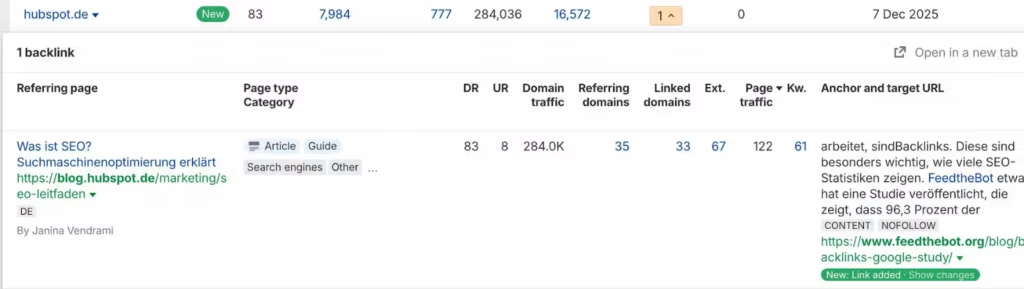
It works because you're solving a problem — the webmaster has a broken link, and you're offering a fix.
Having said that, the effectiveness of the tactic has dropped over the last few years. Website owners expect links or payment in exchange for replacing the 404 with your link these days.
Which is why you’d get only 2-3 links out of 50-60 prospects.
4. Niche edits
Niche edits — also called link insertions — are links the editor adds to content that's already live on an established website.
You look for relevant pages in your niche where the insertion adds value to the existing content, for example, by providing up-to-date research.
5. Listicle link building
Listicle link building is about getting your brand mentioned in list-style articles. "Top 10 Tools for X," "Best Software for Y," that kind of thing.
Why does it work?
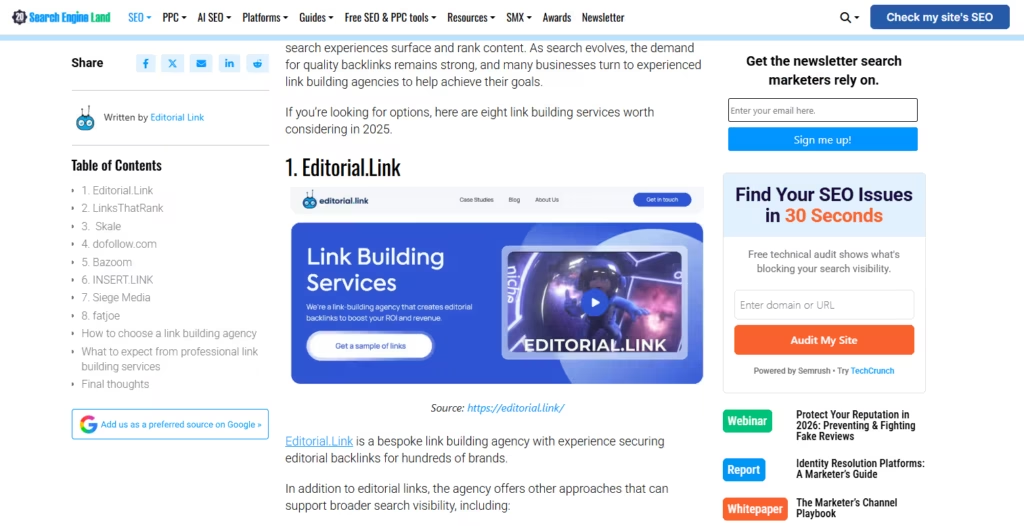
Despite the recent Google "listicle crackdown," quality in-depth listicles still capture traffic with commercial intent, and they keep dominating AI search for high-intent queries.
Step-by-Step Manual Link Building Process
Here's the workflow we use for manual outreach link building.
Step 1: Prospecting relevant websites
Start by finding sites that publish content relevant to your niche.
Google search operators work well for finding relevant placements.
Try intitle:"write for us" [niche] or [topic] intitle:resources inurl:resources.
Ahrefs and Semrush offer tools that let you analyze competitor backlinks, find links they have and you don't, and pinpoint pages with broken links.
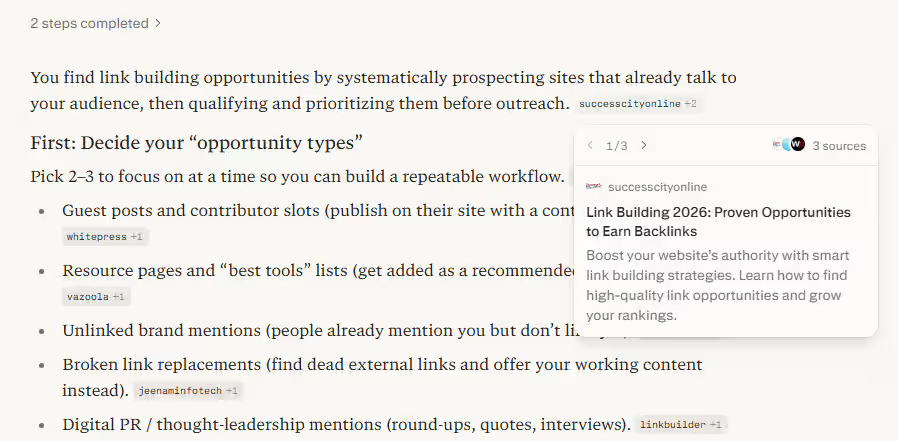
And let's not forget about AI chatbots, the quickest way to find sites that get cited for your target queries.
Step 2: Evaluating link quality
When evaluating the link opportunities, we pay attention to multiple metrics:
- Organic traffic: The page attracts real visitors, who can become your audience via referral traffic.
- Topical relevance: Niche relevance at this stage
- Outbound to inbound link ratio: Many outbound links mean diluted link equity
- Domain authority: Expressed as DR, DA, AS, depending on your SEO link building tool.
Step 3: Finding contact information
Once you have your prospect list, find the right person to contact.
LinkedIn is the best way to find the key decision-makers. Just look at the People tab and filter by "editor", "SEO" or similar keywords.
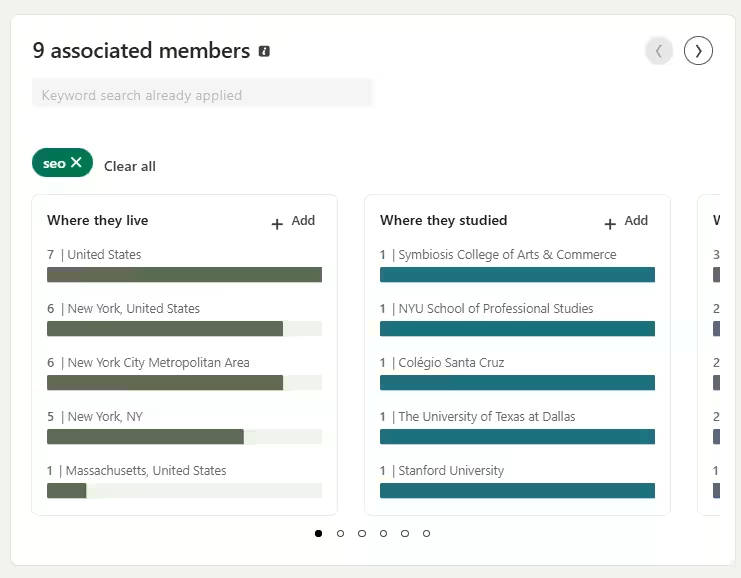
Once you find the right person, send them a connection request and message them 2-3 days after they accept it. From our experience, LinkedIn messages have double the response rate of cold emails.
E-mail still works, though. Use a tool like Hunter.io to find their email address.
A pro move: Don't limit LinkedIn networking to link-building campaigns. Build connections with folks in your niche organically. It's an investment that pays off in the future.
Step 4: Outreach and relationship building
When reaching out to prospects, make your email relevant:
If you're looking for a listicle insertion, name the article and suggest they have a look at your product or service as a potential addition.

No response?
Follow up after 2-3 days. Up to 3 times. Most success comes from the second message.
Step 5: Securing the link placement
Once a prospect agrees, promptly deliver exactly what they need.
For guest posts, match the publication audience and follow style guidelines.
For link insertions, provide the specific URL and a natural anchor text suggestion.
For listicle placements, replicate the tone, style, and format of the original article.
Step 6: Tracking and monitoring links
Once your links go live, you need to monitor them.
Link decay is real, and if you don't catch them early, up to 20% links can disappear within a year for different reasons. Which is a terrible waste of resources.
Also, monitoring links is necessary to prove the ROI of your campaigns.
For basic monitoring, you can use your SEO tool and Google Search Console. There are also dedicated backlink monitoring tools, like Linkody.
Tools for Manual Link Building
Here are a few tools our link builders use to support the process:
- Research and analysis: Ahrefs or Semrush for competitor & backlink gap analysis, and link evaluation. Screaming Frog for finding broken links.
- Outreach and CRM: BuzzStream for advanced campaign staging and team workflows.
- Email finding: Hunter.io for email discovery and verification.
- AI tools: ChatGPT, Claude, or Gemini for email drafting and prospect research.
Common Mistakes in Manual Link Building
I've seen teams repeat the same errors across dozens of campaigns:
- Focusing only on DR/DA. Domain Rating can be easily skewed with cheap links, so never use it in isolation.
- Sending generic outreach emails. Template-blasted emails get ignored. Personalization isn't optional — it's the difference between a 5% and 15% response rate.
- Targeting irrelevant sites. Links from unrelated websites can confuse search engines and hurt rankings.
- Overusing exact-match anchors. It signals manipulation. Google expects a natural mix of branded, generic, and partial-match anchors.
- Scaling too fast. A sudden spike in new links looks unnatural. It's associated with automated link-building.
- Ignoring AI search. AI search engines hold around 56% of the search market worldwide, and AI traffic converts faster.
Manual Link Building vs Link Building Agencies
At some point, you'll ask: Should I build links in-house or hire an agency?
If you already have a competent team in place, building links in-house works out cheaper. If you have to build one from scratch, you'll have to wait for months to see the ROI.
In-house teams also have a smaller capacity than agencies, so they can never deliver as many backlinks.
Finally, thanks to their wide networks, specialist agencies can often deliver links that are out of reach for in-house link-builders.
All this considered, lots of companies complement their in-house capabilities with specialist manual link-building services.
Conclusion
Manual link building requires time and effort. There's no shortcut. But link building remains one of the most effective ways to build lasting search visibility — in both traditional results and AI-powered search.
Focus on relevance over volume. Personalize every outreach email.
Track what works. And if you need help scaling, get in touch with our team for a sample of high-quality backlinks for your project.
FAQ About Manual Link Building
What is the difference between manual and natural backlinks?
Manual backlinks result from active outreach — you identify prospects and ask for links. Natural backlinks happen without your request — someone discovers your content and links to it on their own.
Both are legitimate as long as the link is editorial and adds value. If anything, Google has no way of telling if you asked for the link or not.
Is manual link building safe for SEO?
Yes, manual link building is safe for SEO when done ethically. Focus on creating valuable content, building real relationships, and earning editorial placements — that's all within Google's guidelines. Stick to relevant sites, use a natural anchor text profile, and avoid link schemes.
How long does manual link building take?
Building links manually usually takes 1+ months. Once the links go live, you may see the results in AI search visibility within days, but expect 3-6 months before seeing meaningful search engine ranking improvements.
The timeline depends on your niche's competitiveness, the quality of links acquired, and your site's existing authority.
How can I speed up manual link building?
You can't skip the manual work — but you can make it more efficient. Use AI tools like ChatGPT to draft personalized outreach emails faster. Ahrefs and Semrush speed up prospecting by surfacing competitor backlinks you can target directly.
Outreach CRMs like BuzzStream automate follow-up sequences so nothing slips through the cracks. The goal isn't to automate the relationship — it's to automate everything around it.